Archives and resources for Armenian genealogy

This page describes all the archival collections used to build the content of this site. Each section presents a specific fund or resource, providing a better understanding of the archives and documents related to Armenian genealogy.

Armenian Genealogy

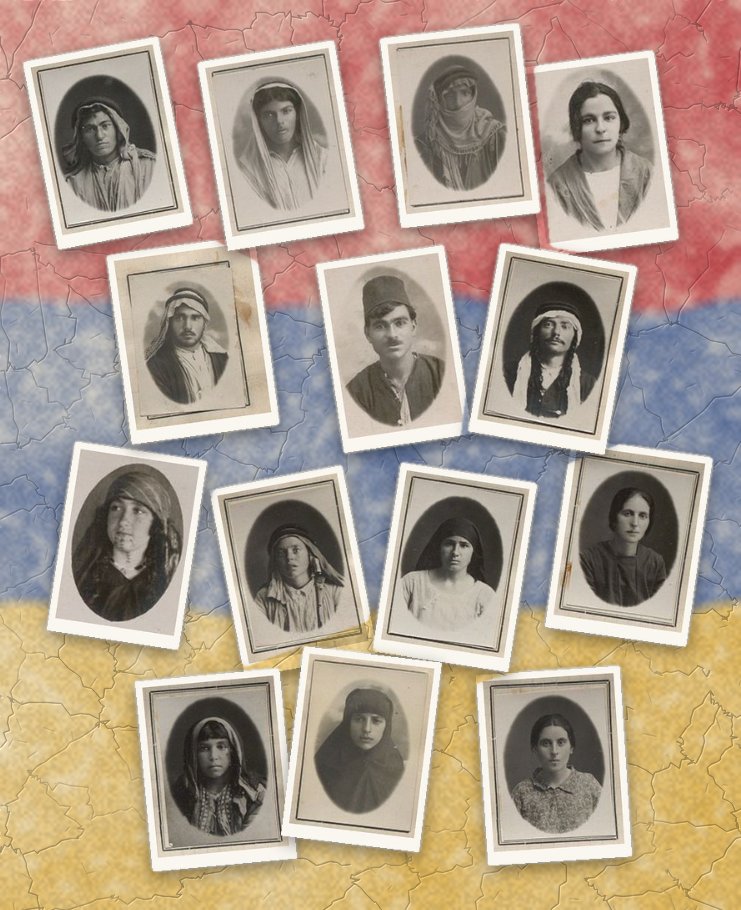
Karen Jeppe – Aleppo Orphanage

The Danish missionary Karen Jeppe (1876–1935) arrived in Urfa in 1903 to work at the orphanage of Johannes Lepsius's German mission. During the genocide she hid Armenians there and helped others escape, disguised as Kurds or Arabs.

In 1921 she settled in Aleppo for the League of Nations commission for the protection of women and children in the Near East. She opened a shelter, the Rescue Home, and secured the release of Armenian women and children held in Arab, Kurdish or Turkish households: nearly 1,700 people by her own count. About a third were reunited with relatives; the others worked in the farming colonies she founded in the Raqqa region.

Each person taken in has a record: photographic portrait, age, home town, parents' names when remembered, date of arrival and an account of their journey since 1915. These registers are held in the United Nations archives in Geneva.

Many orphans did not know their family name: they are recorded as Unknown, which you can type in full in the surname field to find them. Records also list relatives found in other files, one click away.

Over 3,000 records in nearly 1,500 files (1922–1930).
Armenian Genealogy

Paris Census Records — 1926 available in a few weeks

Population censuses are genuine social snapshots of an era. Paris held three nominative censuses between the wars, in 1926, 1931 and 1936; the next one was not taken until 1946. Carried out in the years following the Genocide, the interwar censuses offer a unique window into the capital at the very time Armenian refugees were settling in France.

For genealogy researchers and history enthusiasts alike, they are invaluable tools. They make it possible to trace family histories, pinpoint ancestors in a specific neighborhood or street, and understand their social and professional environment. They provide a snapshot of residents' lives: household composition, addresses, occupations, and sometimes additional details that allow families to be followed across time.

The 1926 Census: Paris between tradition and modernity
Conducted in a context of restored peace, the 1926 census is the first to cover all Parisian arrondissements on a nominative basis. Organized by arrondissement, neighborhood, street, and building number, it facilitates address-based research. Each record lists the full name of each individual, their date and place of birth, occupation, and relationship to the head of household.

This census reflects a society still deeply shaped by traditional family structures, yet already undergoing significant change driven by growing urbanization and the emergence of new professions. It stands as an essential source for understanding daily life in Paris in the mid-1920s.

Armenian Genealogy

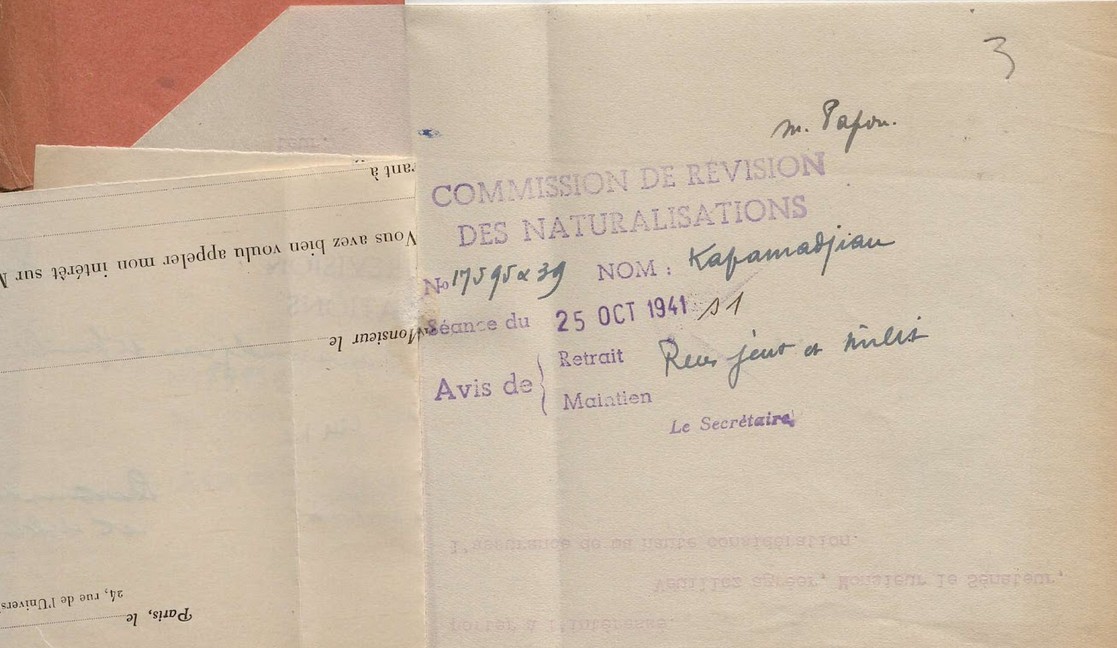
The Vichy Denaturalized

Between 1940 and 1944, under the Vichy regime, thousands of people were stripped of their French citizenship. These measures primarily targeted naturalized citizens of foreign origin — including Jews, Armenians, and other minorities deemed "undesirable."

Based on the law of July 22, 1940, these revocations represented a sharp break with republican principles of equality, affecting individuals who had sometimes lived in France for decades.
A detailed and unique archival collection, held at the National Archives (Pierrefitte-sur-Seine), brings together: nominative lists, individual case files, and in-depth administrative investigations.

These investigations often contain a wealth of information: occupation, migration history, level of integration, and detailed data on family members (spouse, children, parents, grandparents, etc.).

While the individual files are identical, this corpus includes over 800 indexed entries relating to Armenians, compared to around a hundred on the National Archives portal.

Armenian Genealogy

Mémoire des Hommes

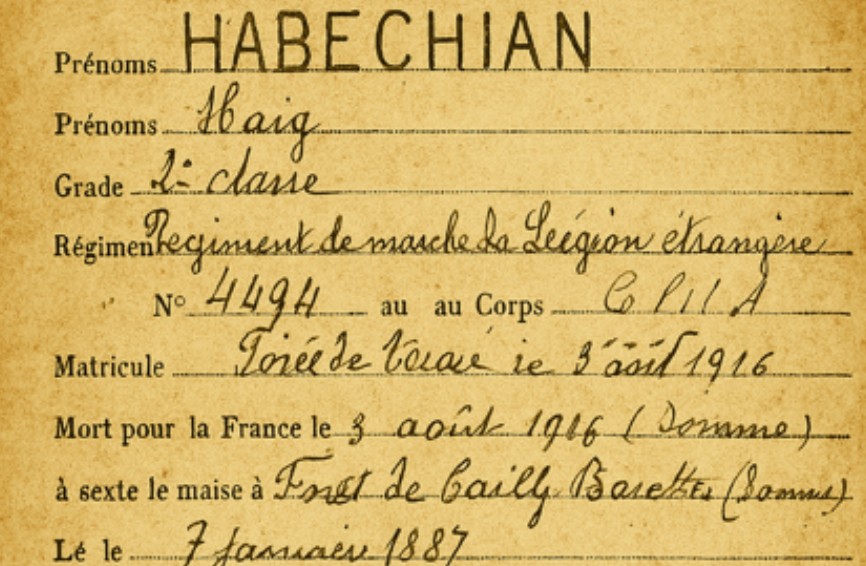
The "Mémoire des Hommes" website, launched in November 2003 by the French Ministry of Armed Forces, is a public platform providing access to digitized archives relating to French military personnel who died in modern conflicts.

Among the thousands of names recorded, particular attention can be paid to Armenians who fought for France — a poignant example of those foreigners who gave their lives for their adopted country.
Many were refugees from the 1915 Genocide or descendants of the Armenian diaspora, and they served with courage during both World Wars and in the Resistance.

One of the most iconic figures is Missak Manouchian, poet and activist, executed by the Nazis in 1944. His name appears in the "Died for France" database, alongside many other Armenian volunteers.

Nearly 500 records are available.

Armenian Genealogy

OFPRA

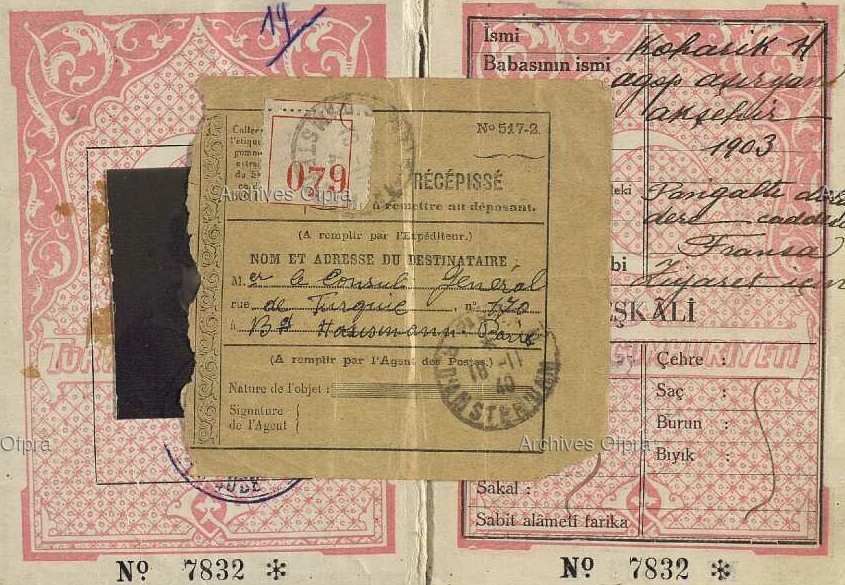
The OFPRA (French Office for the Protection of Refugees and Stateless Persons) holds a major archival collection for understanding the personal journeys of asylum seekers in France since 1952. Each individual file contains application forms, personal accounts detailing persecution endured, supporting documents such as civil records, letters or photographs, as well as official decisions rendered. This collection is a valuable resource for documenting exile, administrative processes, and individual memories — particularly those of Armenian refugees who found shelter in France throughout the 20th century.

By exploring these archives, one can uncover traces of individuals with Armenian names — fragments of family histories, echoes of exile, stories of transmission and memory.

The "Armenian Collection" brings together private and community archives of the Armenian diaspora in France after 1915 — letters, journals, photographs, and associative or administrative documents. It reveals the intimate history of life in exile and gradual integration.

The "Passport Collection" gathers identity papers of Armenian exiles and stateless persons, such as Nansen passports and annotated or translated travel documents. These archives trace the movements, legal challenges, and precarious status of these displaced individuals.

Over 13,000 documents. Some date back to 1800: although the files were opened by the applicants themselves, they often contain records relating to their parents and grandparents.

Armenian Genealogy

INSEE

INSEE (National Institute of Statistics and Economic Studies) is a public body created in 1946, responsible for producing, analyzing, and disseminating official statistics on France's population, economy, and society. Its work supports public decision-making, economic research, and social understanding.

Among its many resources, the death records database is of particular importance. Since 1970, it compiles essential information on deceased individuals, including their name, sex, date and place of birth, and date and place of death.

The extract used on this site is updated once a year and keeps only individuals of Armenian origin. However, it should be noted that some entries may not be directly linked to Armenian ancestry. This is due to the use of automated analysis tools and bots, which can sometimes generate false positives based on name patterns or other heuristic rules.

Over 55,000 records of people who died between 1970 and 2024, born as early as 1907.

Armenian Genealogy

The Moscow Collection

Despite its name, the "Moscow Collection" is a set of French archives: mainly files of the Sûreté générale, the forerunner of the French national police (including its central surveillance index), together with records of the Ministry of War, the intelligence services and some private papers.

These archives were seized by the German army in 1940, taken by the Soviets in 1945 and transferred to Moscow, where they remained for about fifty years. Part of them was returned to France in 1994 and 2004. The police files are now held at the French National Archives, at the Pierrefitte-sur-Seine site.

The names of individuals of Armenian origin mentioned in these documents have been extracted and indexed, making them accessible to anyone wishing to trace a family or community history. As with the INSEE collection, some entries may appear without a confirmed link to Armenian ancestry.

For each identified record, an associated link provides the necessary references and redirects users to the National Archives website to reserve a seat in the reading room.

Over 5,000 records.